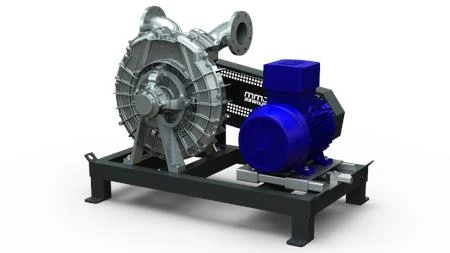
Single stage
EJ-KB series · low/medium differential pressure duties
FLOW RANGE50–1,550 m³/h
CONTINUOUS PRESSURE+250 mbar
PEAK PRESSURE+400 mbar
CONTINUOUS VACUUM−200 mbar
PEAK VACUUM−300 mbar
MOTOR POWER RANGE0.25–15 kW

TMM BLOWER · EXPLOSION-PROOF INDUSTRIAL SOLUTIONS
Side channel blower solutions for compressed air and vacuum duties in processes where explosive atmospheres may occur. Single- and double-stage configurations selected against actual duty requirements.
ATEX technical brochure · pp. 42–43
ATEX technical brochure · pp. 42–43
ATEX technical brochure · pp. 42–43
MANUFACTURER SERIES / ONE PRODUCT PAGE
The ATEX side channel blower family is presented on one product page with two configurations. Final model selection depends on required airflow and operating pressure or vacuum at the duty point.
EJ-KB series · low/medium differential pressure duties
EJ-KBZ series · higher differential pressure duties
Source: ATEX blower technical brochure, pp. 1–4 (technical data: catalogue pp. 42–43). Direct-coupled motor and die-cast aluminium housing and impeller. Flow and pressure figures are series limits; model selection depends on the operating point.
ATEX SUITABILITY
The general product catalogue lists the following gas and dust atmosphere markings for this ATEX side channel blower range.
Do not assume suitability beyond gas subgroup IIA or dust subgroup IIIA. Confirm the zone, substance, temperature class and the complete motor and drive assembly against the selected model’s ATEX documentation.
INDUSTRIAL APPLICATIONS
Pressure or vacuum applications involving flammable gas or vapour risks, subject to verified ATEX suitability.
Gas transport and process air duties where gas composition, atmosphere classification and system safety have been confirmed.
Gas transport, extraction and related process support duties selected for the required differential pressure.
VENSIS ENGINEERING
These details allow the appropriate series and motor configuration to be selected using catalogue technical data. The equipment category and temperature class must match the project conditions.
CATALOGUES & MANUFACTURER DATA
Technical data source: user-supplied ATEX blower technical brochure (catalogue pp. 42–43). Gas/dust ATEX markings: general catalogue ATEX blower page (p. 8).
FREQUENTLY ASKED QUESTIONS
A side channel blower is process equipment designed to produce pressure or vacuum. It has different selection criteria from general ventilation fans. Hazardous-area uses additionally require the correct ATEX classification.
Consider the duty-point airflow, differential pressure or vacuum, power and thermal conditions. Double-stage designs are commonly assessed for higher differential pressure duties. Confirm final selection against the manufacturer’s model curves.
No. Equipment marking, category, gas or dust subgroup, temperature class and installation conditions must match the actual environment. Verify suitability using the selected product’s documentation.
They depend on power, duty point, motor/drive arrangement and ATEX requirements. Fixed prices and stock availability are not listed on this page.
ENGINEERING SUPPORT FOR YOUR PROJECT
Send airflow, pressure, process medium and zone details. Vensis can assist with technical evaluation and quotation.
Vensis technical evaluation and quote enquiries.
This page is an initial selection aid; it does not replace engineering review or ATEX suitability verification.