External articulated joints
A design intended to keep extracted contaminated air separated from moving joints.

ATEX EXTRACTION ARM SERIES
An adjustable, durable local extraction arm designed for industrial areas with potentially explosive gas or dust atmospheres. Four nominal diameters within one product family.
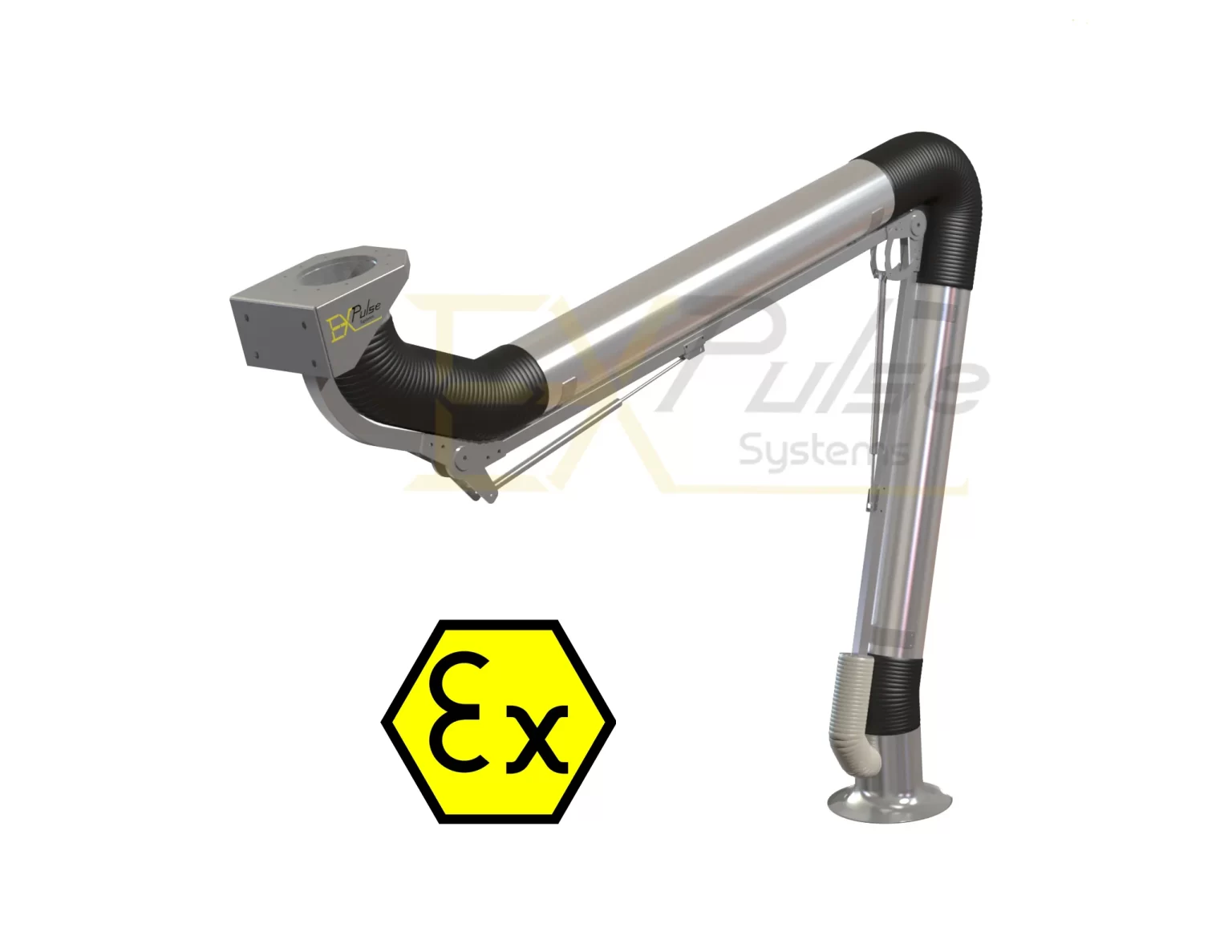
Ø100 · Ø125 · Ø160 · Ø200 mm
Rotation described by manufacturer
AT-series manufacturer description
ONE PRODUCT · FOUR SIZES
AT-100, AT-125, AT-160 and AT-200 are size options within the ATEX extraction arm family, not four separate product listings. Diameter and length are selected for airflow, reach and system pressure loss.
Specifications are published for AT-160 and are not assumed for the other diameters.
ENGINEERED FOR HAZARDOUS AREAS
An II 2GD ATEX category is listed for this product family for gas and dust atmospheres. The hazardous-area classification, handled substance, temperature and connected extraction system must be assessed together.
A design intended to keep extracted contaminated air separated from moving joints.
Wire-grounded flexible duct designed to help control electrostatic charge accumulation.
The AT-160 manufacturer description specifies an AISI 304 body and hood.
Integrated damper for manual regulation of extraction airflow.
Hydraulic-assisted positioning and stable placement as described by the manufacturer.
ATEX suitability and facility safety depend on the selected unit documentation and engineering assessment of the entire extraction system.
APPLICATION AREAS
Local capture of dust, gases or vapours near process handling and mixing points.
Local extraction in grinding, machining and other potentially hazardous particulate processes.
Adjustable source extraction where site hazard classification and system design allow.
VENSIS ENGINEERING
An extraction arm is not a fan or dust collector. Airflow and total system pressure drop must be considered when choosing the connected fan and filtration solution.
FREQUENTLY ASKED QUESTIONS
No. This page treats them as nominal diameter variants of a single ATEX extraction arm family.
No. The arm is a local extraction component and requires a compatible extraction fan and, where necessary, a filtration system.
It is the equipment category stated by the manufacturer for gas and dust applications. Suitability depends on the selected configuration documentation and installation conditions.
The AT-160 listing specifies Ø160 mm, recommended airflow 1,200–2,000 m³/h, pressure drop 400–800 Pa, and lengths of 2, 3 and 4 metres.
Pricing depends on diameter, length, quantity, installation and ATEX details. No fixed price or stock commitment is shown.
FOR YOUR PROJECT
Send the required diameter, reach, hazardous-area classification and airflow needs for a Vensis technical review and quotation.
Vensis technical assessment and quotation request.
ATEX suitability and facility safety depend on the selected unit documentation and engineering assessment of the entire extraction system.
Technical source: ATEX extraction arm product page